
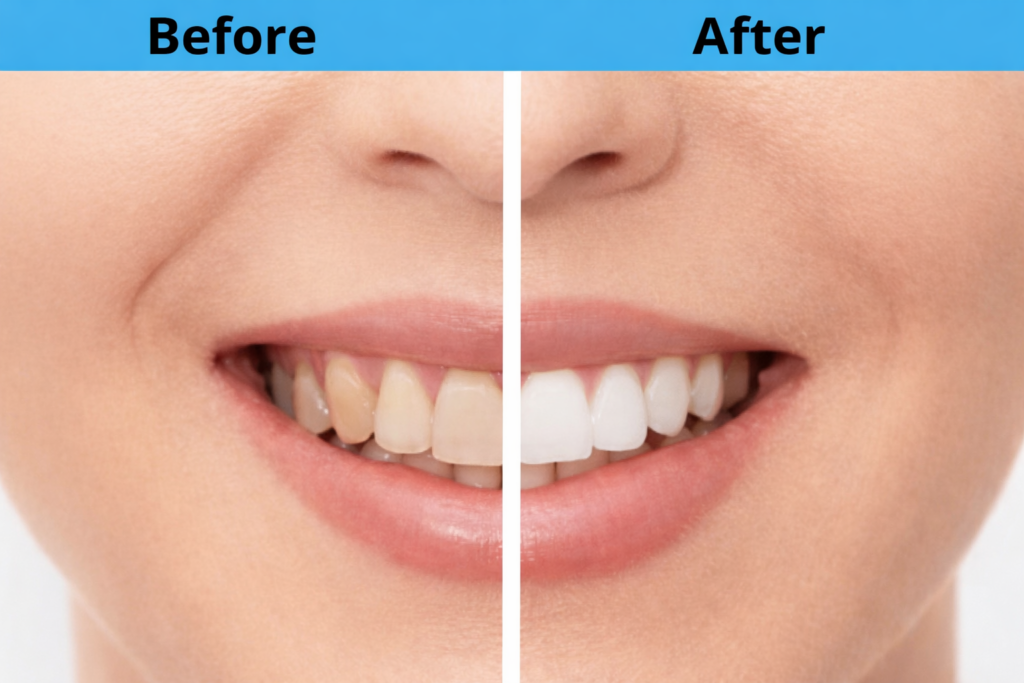
Internal Whitening
You’ve tried the whitening strips. You’ve bought the expensive toothpaste. Furthermore, you’ve maybe even had professional whitening trays made. And while the majority of your smile looks brighter, there is that one tooth that refuses to cooperate. It remains stubborn, standing out with a grey, brown, or dull hue against the rest of your pearly whites.
It can be incredibly frustrating. It makes you feel self-conscious about smiling, even though you’ve put in the effort to take care of your teeth.
Here is the reality: no amount of surface scrubbing or standard bleaching gels will fix that single dark tooth. That’s because the discolouration isn’t a stain on the surface; the problem lies deep within the tooth itself. But there is good news. A specialized procedure known as internal whitening—often called the “walking bleach” technique—can target that specific tooth and brighten it from the inside out.
Why does a single tooth go dark?
To understand the cure, we first have to understand the cause. Most teeth discolour because of external factors like coffee, tea, red wine, or tobacco. These are surface stains that live on the enamel.
A single dark tooth, however, usually tells a different story. This discolouration is almost always caused by trauma or a previous root canal treatment.
When a tooth suffers significant trauma—like a hit from a sports ball or a deep cavity—the nerve inside the tooth (the pulp) can die. As the pulp tissue breaks down, it releases blood products and pigments that seep into the dentine, the layer of the tooth just underneath the enamel. Over time, this darkens the tooth significantly. It’s essentially a bruise that never heals, trapped inside the hard shell of your tooth.
Similarly, past dental materials used in root canals can sometimes cause staining. Because the darkness is coming from the core of the tooth, applying bleach to the outside is like trying to change the colour of a wall by painting the window; it just doesn’t reach the source of the problem.
What is internal whitening?
Internal whitening is exactly what it sounds like: a method of whitening bleaching the tooth from the inside. It is a strictly professional procedure performed by a dentist or an endodontist (a root canal specialist).
Unlike standard whitening, which affects all your teeth, this procedure focuses solely on the non-vital tooth—the one that has had a root canal. If the tooth hasn’t had a root canal yet but is dead, that treatment must be completed first before whitening can begin.
The "Walking Bleach" process
The procedure is surprisingly simple and painless for the patient. It’s often called the “walking bleach” technique because the whitening process actually happens while you are walking around, living your daily life between dental appointments.
Here is what you can typically expect during the appointment:
1. Assessment and Access
Your dentist will first take an X-ray to ensure the root canal filling is sound and the bone looks healthy. Once cleared, they will create a small access hole in the back of the tooth—the same spot used for the original root canal. This means no drilling on the front face of your teeth, so the structure remains intact.
2. Creating a Barrier
This is the most critical safety step. The dentist will place a protective seal over the root canal filling material at the bottom of the empty chamber. This barrier prevents the bleaching agent from leaking down into the root, which is vital for the long-term health of the tooth.
3. Applying the Whitening Agent
A specialised whitening gel bleaching paste (usually sodium perforate mixed with water or hydrogen peroxide) is placed into the hollow chamber of the tooth.
4. The Temporary Seal
The dentist seals the access hole with a temporary filling material. This keeps the gel bleach inside and food particles outside. You then go home, and the gel bleach works its magic over the next few days.
5. Follow-up
You will usually return to the dentist in 2 to 41 weeks. If the tooth is white enough, the gel bleach is removed, and a permanent filling is placed. If it needs to be brighter, the dentist will repeat the process with fresh whitening gel bleach.
Internal Whitening vs. Veneers or Crowns
When faced with a dark tooth, many patients assume their only option is a porcelain veneer or a crown. While these are valid treatments, they are much more invasive.
To place a crown or veneer, a dentist must shave down healthy tooth structure to make room for the porcelain. It is an irreversible process. Internal whitening, on the other hand, is conservative. It preserves the natural tooth structure you have left. It is also significantly more cost-effective than restorative porcelain work.
However, internal whitening isn’t permanent. Over time (usually several years), the tooth may begin to darken again, requiring a touch-up. Veneers offer a more permanent colour fix but come with higher maintenance and replacement costs down the road.
Is it safe?
Internal whitening is generally safe when performed by an experienced professional, but it isn’t without risks. The main concern is a condition called external cervical resorption, where the body starts to dissolve the root of the tooth. This is rare, but it is why that protective barrier step mentioned earlier is so important.
It is also important to have realistic expectations. The goal is to get the dark tooth to blend in with its neighbours. Perfect symmetry isn’t always possible, but the improvement is usually dramatic enough that the tooth no longer draws the eye when you smile.
Bringing light back to your smile
A single dark tooth can affect your confidence, making you hide your smile in photos or cover your mouth when you laugh. You don’t have to live with it, and you don’t necessarily need expensive crowns to fix it.
Internal whitening offers a conservative, effective path to restoring the natural beauty of your smile. By targeting the discolouration at its source, you can finally get that stubborn tooth to match the rest of your smile.
If you have a tooth that has darkened following trauma or a root canal, ask your dentist if you are a candidate for the walking bleach technique. It might be the brightest decision you make for your oral health.