

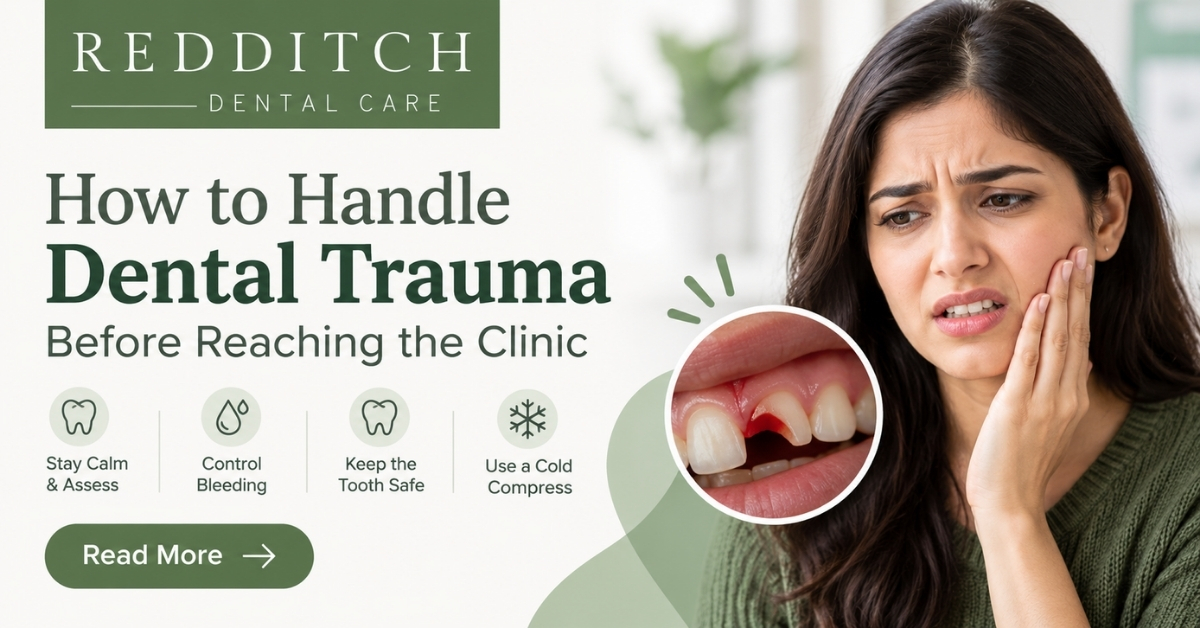
How to Handle Dental Trauma Before Reaching the Clinic
Dental trauma — whether a knocked-out tooth, a chip, or a soft tissue injury — requires fast, calm action. Rinse the area gently, control any bleeding with clean gauze, preserve any displaced teeth in milk or saliva, and contact your dentist immediately. Acting within the first 30–60 minutes can make the difference between saving and losing a tooth.
Accidents happen when you least expect them. A fall in the garden, a clash of heads on the football pitch, biting down on something unexpectedly hard — and suddenly you’re holding a tooth in your hand, or spitting blood and wondering what on earth to do next.
Dental trauma can feel overwhelming, especially if it happens to a child. But the steps you take in the minutes before reaching the clinic can genuinely affect the outcome. Some injuries are fully reversible with prompt, correct action. Others become permanent problems simply because the right first aid wasn’t applied in time.
This guide walks you through exactly what to do — calmly, clearly, and in plain English.
What counts as dental trauma?
Dental trauma is any injury to the teeth, gums, lips, jaw, or surrounding structures. It covers a wide range of incidents, from a small chip on the corner of a tooth to a tooth being completely knocked out of its socket (known as an avulsion).
Common types include:
Chipped or fractured teeth — the most frequent type, often painless initially
Loosened teeth (luxation) — the tooth is still in place but feels wobbly or displaced
Knocked-out teeth (avulsion) — the tooth has come out entirely
Root fractures — damage below the gumline, often invisible to the eye
Soft tissue injuries — cuts or lacerations to the lips, tongue, or gums
Each type requires slightly different first aid, but the core principles remain the same: stay calm, act quickly, and get professional help as soon as possible.
What should you do if a tooth gets knocked out?
A knocked-out permanent tooth is a Dental Emergency. Speed is critical here — according to the International Association of Dental Traumatology (IADT), the chances of successfully replanting a tooth drop significantly after 60 minutes outside the socket.
Here’s what to do, step by step:
Pick up the tooth by the crown (the white part you can see), not the root. Touching the root can damage the cells needed for reattachment.
If the tooth is dirty, rinse it gently under cold milk or saline. Don’t scrub it, and don’t use tap water if you can avoid it — tap water can damage the root surface cells.
Try to reinsert the tooth into the socket straight away, if possible. Hold it gently in place and bite down softly on a clean cloth to keep it there.
If reinsertion isn’t possible, store the tooth in a small container of cold milk, or tuck it inside the cheek between the gum and inner lip (for adults only — not children who may swallow it). Saliva is a reasonable short-term alternative.
Contact your dentist immediately and go to the clinic as soon as possible. Mention it’s an emergency — most practices, including Redditch Dental Care, offer same-day emergency appointments.
Do not store the tooth in a dry tissue or cup of water. Dry storage kills the root cells within minutes. Milk is the best readily available option because its chemical composition helps preserve the viability of those cells.
How do you handle a chipped or cracked tooth?
A chipped tooth might not look like an emergency, but it’s worth treating urgently, especially if there’s pain or sensitivity.
Rinse your mouth gently with warm water.
If there’s any bleeding from the gum or lip, apply gentle pressure with clean gauze or a damp cloth for 10 minutes.
If the broken piece of tooth is large enough, keep it — bring it to your appointment. In some cases, it can be reattached.
Take over-the-counter pain relief (such as paracetamol or ibuprofen) if needed, following the instructions on the packet.
Avoid hot or cold drinks until you’ve been seen, as the exposed inner layer of the tooth (dentine) can be very sensitive.
Even a small chip can expose the nerve over time, so don’t put off booking an appointment.
What if the tooth is still in place but feels loose?
A tooth that has been pushed in, pulled out slightly, or shifted sideways is known as a luxated tooth. Don’t try to force it back into position yourself — this can cause more damage.
Leave the tooth as it is and avoid touching it with your tongue or fingers.
Eat only soft foods and avoid biting on that side of your mouth.
Contact your dentist right away. Luxation injuries need to be assessed and often stabilised with a splint.
How do you manage bleeding from the mouth?
Mouth injuries can bleed more than expected because of the high concentration of blood vessels in oral tissue. That said, most mouth bleeding responds well to simple first aid.
Apply firm but gentle pressure using clean gauze, a clean folded cloth, or a damp teabag (the tannins in tea can help slow bleeding).
Hold the pressure in place for at least 10–15 minutes without lifting to check.
If bleeding doesn’t slow down after 20–30 minutes, or if there’s a large laceration, go to your nearest A&E.
For cuts inside the cheek or lip, a cold compress on the outside of the face can help reduce swelling alongside the direct pressure inside.
Should you go to A&E or straight to a dentist?
For most dental trauma, your first call should be to your dentist. Dental practices are better equipped than A&E to handle tooth-specific injuries — A&E departments can manage bleeding and pain but generally cannot replant teeth or provide the restorative treatment you’ll need.
Call your dentist first, explain the situation, and they’ll guide you on what to do next.If your dental practice is closed, seek an out-of-hours emergency dental service in your area.
You should go to A&E if:
There is heavy, uncontrolled bleeding
You suspect a jaw fracture
There is loss of consciousness, confusion, or a head injury
You are having difficulty breathing or swallowing
What about children’s milk teeth — do they need the same treatment?
Not quite. If a child knocks out a milk (baby) tooth, you should not attempt to reinsert it. Putting a baby tooth back in the socket can damage the developing permanent tooth underneath.
Do, however, keep the tooth so your dentist can confirm it is actually a baby tooth and not a permanent one. Then call the practice to get advice and book a check-up. Even without reinsertion, the area should be assessed for any damage to the surrounding gum or bone.
Act fast, then get expert help
Dental trauma is stressful, but knowing what to do in advance takes some of the panic out of the moment. The golden rules are simple: stay calm, protect the tooth or injured tissue, control any bleeding, and contact your dentist without delay.
At Redditch Dental Care, we offer same-day emergency appointments and have been caring for patients in Redditch and the surrounding West Midlands for over 40 years. If you or someone in your family has experienced a dental injury, call us on 01527 545361 or book online — we’ll get you seen as quickly as possible.
Frequently asked questions about dental trauma
Can a knocked-out tooth be saved?
Yes, in many cases. The key factor is time. A permanent tooth reimplanted within 30 minutes has the best chance of survival. After an hour outside the mouth, the outcome becomes much less certain. Store the tooth in milk and get to a dentist immediately.
Does dental trauma always cause pain?
Not always. Some injuries — including root fractures and certain luxations — can be painless at first. The absence of pain does not mean the tooth is uninjured. Always get a professional assessment after any blow or impact to the mouth.
What if I can’t reach my dentist straight away?
Keep the tooth moist (in milk or saliva), apply a cold compress to reduce swelling, take paracetamol or ibuprofen for pain, and keep trying to contact a dental practice. NHS 111 can also help direct you to an out-of-hours emergency dentist.
Can chipped teeth be repaired?
Yes. Depending on the size and location of the chip, options include dental bonding, a veneer, or a crown. Bring any broken tooth fragments to your appointment — they may be usable.