

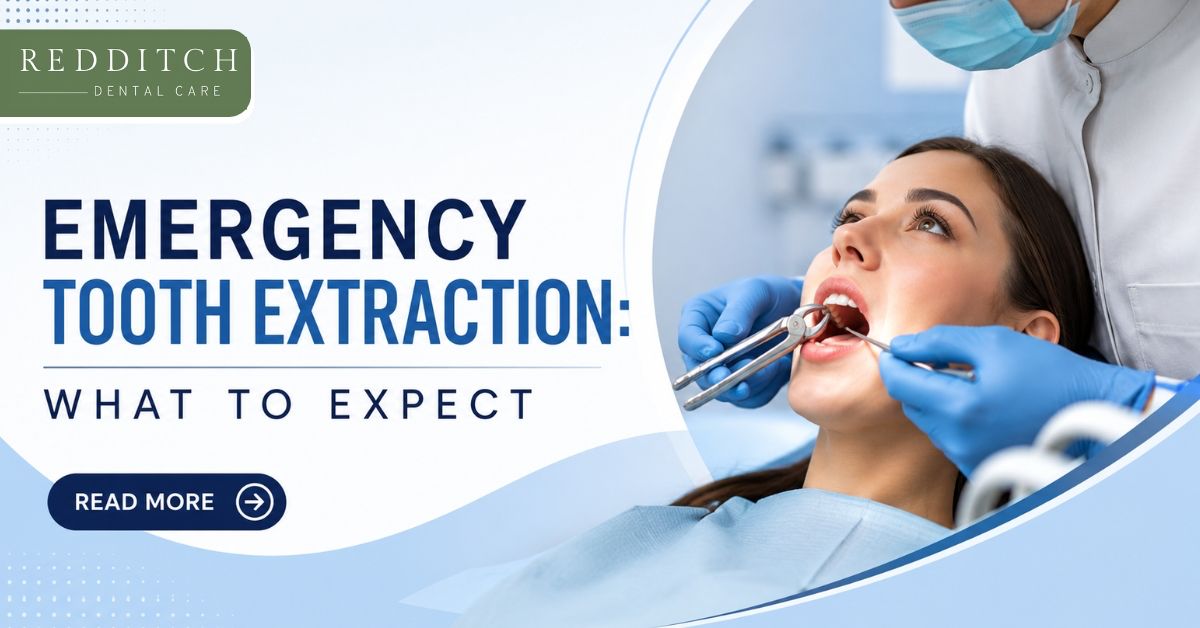
An emergency tooth extraction removes a tooth that is causing severe pain, infection, or damage that cannot be treated any other way. The procedure itself is quick and carried out under local anaesthetic, so you feel pressure but not pain. Recovery usually takes a few days, and following simple aftercare steps helps your mouth heal properly. If you need urgent care, call us at Redditch Dental Care on 01527 545361.
Losing a tooth in a hurry is unsettling. You are likely in pain, unsure what happens next, and worried the whole thing will hurt. We understand that, and we want to put your mind at ease before you even sit in the chair. At Redditch Dental Care, we have carried out emergency extractions for patients across Redditch and the West Midlands for over 40 years. This guide walks you through exactly what an emergency extraction involves, why it may be needed, and how to recover comfortably afterwards.
What Is an Emergency Tooth Extraction?
An Emergency Tooth Extraction is the removal of a tooth that needs to come out quickly to stop pain, control infection, or prevent further damage. Unlike a planned extraction, an emergency case cannot wait for a routine appointment weeks down the line.
We always try to save a natural tooth first. Fillings, root canal treatment, and crowns let us keep a damaged tooth in place in many situations. An extraction becomes the right choice when the tooth is too badly damaged or infected to repair safely. If we recommend removing a tooth, it’s because keeping it would pose a greater risk to your comfort or overall oral health.
The takeaway: Extraction is not our first option. It is the option we reach for when it protects your health better than any alternative.
Why Might You Need an Emergency Extraction?
Several problems can bring on the kind of pain or risk that calls for urgent removal. Here are the most common reasons we see.
Severe Tooth Decay
When decay reaches deep into a tooth, it can destroy the structure that holds it together. If there is not enough healthy tooth left to support a filling or crown, removal is often the safest path. Left in place, a badly decayed tooth can trigger repeated infections.
Dental Abscess
An abscess is a localized infection that forms at the root of a tooth or within the surrounding gum tissue. It causes throbbing pain, swelling, and sometimes a fever or bad taste in the mouth. If the tooth cannot be saved with root canal treatment, we remove it to clear the infection and stop it spreading to your jaw or neck.
Cracked or Fractured Tooth
A tooth can crack from a fall, a sports knock, biting something hard, or grinding your teeth at night. When the crack runs below the gum line or splits the tooth, repair is not possible. In these cases, extraction relieves the pain and prevents infection from setting in.
Impacted Wisdom Tooth
Wisdom teeth often struggle to break through properly. When one becomes impacted — stuck against the tooth in front or trapped under the gum — it can cause pain, swelling, and repeated infection. We remove impacted wisdom teeth to ease these symptoms and protect the neighbouring teeth.
The takeaway: Most emergency extractions come down to decay, infection, trauma, or a wisdom tooth causing trouble. Each one has a clear reason behind it, and we explain yours before we begin.
What Happens During the Procedure, Step by Step
The unknown is often the scariest part. Knowing what to expect makes the whole experience far less daunting, so here is exactly how we handle an extraction.
- We assess and take an X-ray. We examine the tooth and take an image to see the root and surrounding bone. This tells us the best way to remove it.
- We numb the area. We apply a local anaesthetic so the tooth and gum are completely numb. You stay awake, but you feel no pain during the procedure.
- We loosen the tooth. Once you are numb, we gently rock the tooth to widen the socket. You feel pressure at this stage, not sharpness.
- We remove the tooth. For a straightforward extraction, the tooth lifts out cleanly. If a tooth is impacted or broken, we may remove it in sections through a small opening in the gum.
- We clean and close the socket. We clean the area and place gauze for you to bite on. In some cases we add a couple of stitches to help the gum heal.
- We talk you through aftercare. Before you leave, we’ll explain how to care for the treated area and what you can expect over the next few days.
Most single extractions take between 20 and 40 minutes. We work carefully and check in with you throughout, so you never feel rushed or left in the dark.
The takeaway: You feel pressure, never pain. The anaesthetic does the hard work, and we guide you through every step.
What to Expect During Recovery
Recovery from a routine extraction usually takes a few days, with the socket healing fully over a few weeks. A little bleeding, swelling, and tenderness in the first day or two is completely normal. Following our aftercare advice keeps you comfortable and lowers the risk of complications.
Aftercare in the First 24 Hours
The first day matters most, because a blood clot needs to form in the socket to protect it while it heals.
- Bite gently on the gauze we provide for 30 to 45 minutes to help the clot form.
- Rest for the remainder of the day and avoid strenuous activity or heavy lifting.
- Do not rinse, spit, or poke the area, as this can dislodge the clot.
- Keep your head slightly raised when you lie down to reduce bleeding.
- Avoid alcohol and smoking, as both can slow the healing process.
Managing Pain and Swelling
Some discomfort is expected once the anaesthetic wears off, and it is easy to manage at home.
- Take over-the-counter pain relief such as ibuprofen or paracetamol, following the instructions on the packet.
- Hold a cold compress against your cheek for 20 minutes on, 20 minutes off, to reduce swelling.
- From the day after, rinse gently with warm salt water — half a teaspoon of salt in a glass of warm water — a few times a day.
Foods to Eat and Foods to Avoid
What you eat in the first few days affects how well the socket heals.
- Eat: soft foods such as soup, yoghurt, mashed potato, scrambled eggs, and smoothies eaten with a spoon.
- Avoid: hot, crunchy, chewy, or spicy foods that can irritate the area.
- Avoid straws for at least a few days, as the suction can pull out the clot.
- Chew on the opposite side of your mouth until the area feels comfortable.
The takeaway: Protect the clot, keep the area clean, and stick to soft foods. Do this and most people feel much better within three to five days.
When to Call the Dentist After an Extraction
Mild pain and swelling settle on their own. Certain signs, though, mean you should get back in touch with us so we can check on your healing.
Contact us if you notice:
- Bleeding that does not slow down after several hours of gentle pressure
- Pain that gets worse after two or three days rather than better
- A throbbing ache with a bad taste or smell, which can signal a dry socket
- Swelling that increases instead of easing
- A high temperature, which may point to an infection
A dry socket happens when the protective clot is lost too early, leaving the bone exposed. It is uncomfortable but treatable, and we can ease it quickly once we see you. Never hesitate to ring us if something does not feel right. We would always rather check than have you worry at home.
The takeaway: Trust your instincts. If your recovery feels off, call us and we will take a look.
Common Mistakes to Avoid
A few small missteps can slow your healing. Here is what to steer clear of.
- Rinsing too soon. Wait a full 24 hours before rinsing, or you risk dislodging the clot.
- Smoking early. Smoking is one of the leading causes of dry socket. Hold off for as long as you can.
- Skipping pain relief until it hurts. Staying ahead of discomfort is far easier than chasing it.
- Returning to hard foods too quickly. Give the socket time before you test it with crunchy or chewy food.
Quick Recovery Checklist
- Bite on gauze to form the clot
- Rest for the first 24 hours
- Use a cold compress for swelling
- Take pain relief as directed
- Rinse with warm salt water from day two
- Stick to soft foods and skip straws
- Avoid smoking and alcohol
- Call us if pain, bleeding, or swelling worsens
Frequently Asked Questions
Does an emergency tooth extraction hurt?
No. We numb the area fully with a local anaesthetic, so you feel pressure and movement but not pain. Any tenderness afterwards is easily managed with over-the-counter pain relief.
How long does recovery take?
Most people feel noticeably better within three to five days. The socket continues to heal beneath the surface over the following few weeks. Following our aftercare advice keeps you comfortable throughout.
Can I go back to work the next day?
Many patients return to work the following day, especially with a desk-based job. If your work is physically demanding, we suggest resting for a day or two to protect the healing socket.
What is a dry socket and how do I avoid it?
A dry socket occurs when the protective blood clot is lost before the area has healed, exposing the bone. You can lower your risk by avoiding smoking, straws, and vigorous rinsing in the first few days. If you develop a throbbing ache with a bad taste, contact us and we will treat it.
Will I need the tooth replaced?
It depends on which tooth is removed. We discuss replacement options such as a dental implant, bridge, or denture once the area has healed. We will talk you through what suits your mouth and your budget.
Does Redditch Dental Care offer same-day emergency appointments?
Yes. We provide same-day emergency dental care at our practice on Salop Road, Redditch. Call us on 01527 545361 and we will do everything we can to see you quickly.
Ready When You Need Us — Get in Touch Today
An emergency extraction sounds frightening, but the reality is far gentler than most people fear. The procedure is quick, the anaesthetic keeps you pain-free, and recovery is straightforward when you follow a few simple steps. We have looked after dental emergencies across Redditch and the West Midlands for over 40 years, and we bring that experience to every patient who walks through our doors in pain.
If you are dealing with severe toothache, swelling, or a damaged tooth, do not wait it out. Call us on 01527 545361, email [email protected], or book an appointment online. The sooner you reach us, the sooner we can help you feel comfortable again.